Showing posts with label safety. Show all posts

Friday, November 18, 2022

RWC Rescue Loop For Extreme Rescue


Pioneered in Hawaii more than 18 years ago by Waterman Archie Kalepa, the goal was to enable quicker rescue pick-ups instead of the left-hand grab. It proved itself in extreme conditions at Peahi (Jaws).

With the help of Archie, Waterman Unlimited designed our RWC (Rescue Water Craft) Rescue Ring for extreme rescue personnel.  Our bright orange, large polypropylene line with a large inner foam soft grip ring, make this the perfect addition to your tow-in, or rescue watercraft. 

For more see this video on Rigging and using the AK Rescue Ring https://youtu.be/BhW_iUiaIFI

Tuesday, September 20, 2022

Pro Surfers practice Jet Ski Rescue Training for Big Wave Surfing

Best time to train is in a controlled environment, so when things go sideways on the big day there is no question on what the right decision is to make.

Friday, March 11, 2022

Airman At Sea


MACDILL AIR FORCE BASE, Fla. --  U.S. Air Force Senior Airman Garrett Stevens, 6th Security Forces Squadron marine patrolman, operates a jet ski in Tampa Bay, Florida, MacDill Air Force Base, Florida, March. 7, 2022. Marine patrol Airmen utilize boats, jet skis, and all-terrain vehicles to patrol and enforce all of MacDill’s coastal restricted area. (U.S. Air Force photo by Airman 1st Class Hiram Martinez)

Friday, March 20, 2020

Extractor Pro Model PWC Rescue Sled


Special Aquatic Service (SAS) Water Safety first utilized the Extractor sleds back in 1997 and found them to be invaluable for PWC rescue operations and event support. Today, the Extractor PRO model has been an industry standard for quick rescue pick ups in the surfline, rivers and other near shore situations for the past 20 years. This model, due to its size and weight, is designed for use with PWC’s where a single rescue operator is available to operate the PWC, or may be used in situations where a rescue swimmer is used to assist the victim.

Extractor made the ‘original’ PWC rescue sled in winter of 1991 and patented the water rescue sled back in 1993.  Several revisions have been created over the years to improve durability, performance and adapt the sled to be able to connect with ever-changing hull designs of various personal watercraft.  Current sled designs have features that take into consideration the many different makes and models of personal watercraft.

Not all personal watercraft makes and models are ideal for connecting and using a rescue sled. For the models that do, the optimum connection between personal watercraft and sled differ slightly. Some pwcs already come with hard points ideal for towing, and some pwcs still require installation of hard points onto the rub rails, seat housing, transom or stern in order to provide the most stable and secure connection. 

Taking the time to properly mount your sled is critical: a sled that is too loose or too tight on the transom above the jet, can affect maneuverability and stability. In the worst-case scenario, this could damage your boat, the sled itself, or cause serious injury.

When mounting your sled, you will always want to keep three points for attaching the stern. Some connection systems utilize a solid hitch connection and others use soft rigging, like rope or webbing.  The solid hitch or the middle rope become the main tow point.  Ideally the shorter the connection is between the sled and pwc, the more the board will be stable in the water.

The Extractor Jet Ski Rescue Sled is the result of 30 years of experience, manufacturing several revisions of sleds, using different materials and construction methods along the way. Ultimately, the end users and customers have driven the demand for the current design, using the most durable materials, which can be molded into a hull shape that optimizes functionality for being towed behind a watercraft, which do not delaminate from water pressure working on glued seams, rot from sitting in the salt water or sun, and are recyclable, so they don’t end up polluting the ocean or taking up space in land-fills. The plastic is easily repaired and welded, minimizing time out of commission. 

Check out Extractor Sleds full line of sleds and rescue equipment

Tuesday, February 25, 2020

Rescue Watercraft for the Fire Service


The fire service is the epitome of adapting to the changing environment and the needs of the community. The leadership of the fire service continues to evaluate and meet the needs to our dynamic environments and response districts. The fire service of 2020 is not what the fire service of 2000 was, nor what it was in the ‘90s, ‘80s, or any previous era.

The public’s interest in the fire department goes much deeper than making sure we can handle any fire incident. We are the all-hazards agency that continues to be tasked with greater responsibility for helping those who live in or visit our communities. Many agencies have taken on more increased roles with the same or even less staffing. The term “emergency services” better defines our agencies today as we do much more the fight fires.

An area that has always received our attention is water-related emergencies. Today, we have more options to address emergencies on or in the water. The hazards in water-related rescues are vast and complicated. Swiftwater, ocean, and lake and pond environments have many different features without considering the environmental impacts.

In 2018, the Coast Guard counted 4,145 accidents that involved 633 deaths, 2,511 injuries, and approximately $46 million dollars of damage to property as a result of recreational boating accidents. These accidents contributed to a fatality rate was of 5.3 deaths per 100,000 registered recreational vessels. (1)

Open water is a term that includes natural bodies of water (lakes, rivers, oceans) and man-made bodies of water (canals, reservoirs, and retention ponds). In 2016, open water drownings made up 43 percent of fatal childhood drownings (2).

If your agency has any open water, you must take these statistics seriously, complete a needs assessment, and look for ways to prevent these incidents. Beyond prevention, you must adequately prepare for and respond equipped and trained to rescue those in need.

Read More

Thursday, September 19, 2019

Secret Service Wants Jet Skis to Protect Trumps: 'The First Family is Very Active in Water Sports'


The United States Secret Service wants to purchase two jet skis that would be used to train agents and help protect President Donald Trump—along with his family and friends—while at vacation properties located near the water, such as his exclusive south Florida Mar-a-Lago resort, according to an order request posted Monday.

The federal agency requested two Kawaski jet skis, watercrafts that each retail from $9,999 to $15,299. The request noted security challenges that special agents face when traveling with Trump to places such as Mar-a-Lago and the Hamptons.

"President Trump and his family spend several weeks throughout the year in Mara Largo FL and Hamptons NY. The First Family is very active in water sports," the request reads, which was first highlighted by Washington-based WRC-TV reporter Scott McFarlane.

"Several family members along with their guest participate in open water activities for which USSS Special Agent Rescue Swimmers are responsible," the request continues. "SA's have rented watercraft with their own personal funds to allow them to be near our protectees in various water environments to fulfill the USSS Rescue Swimmer mission."

The Secret Service said the jet skis would primarily be used for training exercises and would be stored at a training facility in Beltsville, Maryland. They would be transported via a dual trailer, which the agency also wishes to purchase.

's unclear as to when the jet ski quotes are due, considering the posting lists Tuesday but also says September 18 as the deadline, which would be Wednesday.

Currently, the Secret Service provides rescue watercraft training in North Carolina during a one-day course. However, the agency explained in its request, a three- or four-day training course provided by agents who are rescue swimmer instructors would be "more appropriate to become a proficient operator/rescuer on a" rescue watercraft.

The jet skis will "be outfitted with rescue sleds (in a separate purchase) that will be used by USSS Rescue Swimmers as training tools, as well as assets that can be used on a variety of protective missions, as needed," the request added.

The Secret Service also noted the agency's former partnership with local officials in Hawaii for when former President Barack Obama and his family vacationed there, stating that rescue swimmers used and trained with jet skis for the same reasons.

Sunday, August 25, 2019

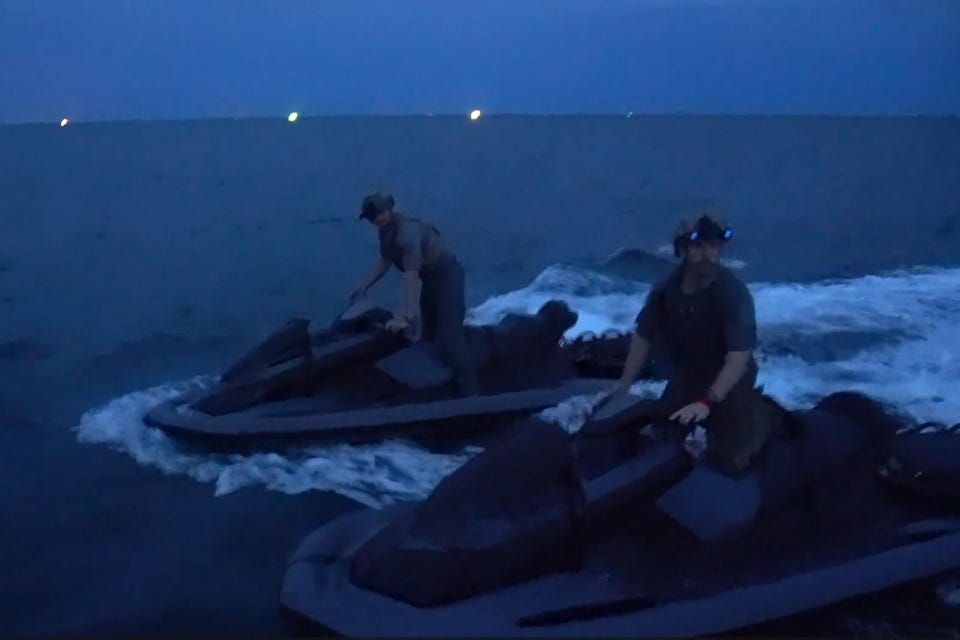
Naval Special Warfare Operating Jet Skis


Ever wondered how the Navy would pluck wounded special forces operators from an enemy beach, fast? Getting off an exposed beach in one piece, under incoming fire, is surely one of the most dangerous operations imaginable. It requires speed and great confidence in the personnel and machines involved. Surprisingly perhaps, commercial off-the-shelf water scooters, similar to the personal watercraft used by water sports enthusiasts the world over, are a popular solution among special forces.

Naval Special Warfare Command’s love of the humble Jet Ski, and they call them that even in official documents, has gone under the radar for many years. But they are now cropping up more and more often in the public domain. The Navy released photos of Jet Skis being used by Special Operations Forces in Greece in 2017, and with Thai forces during Exercise Tempest Wind 2019 in June. Most recently U.S. Special Operations Command issued a request for three Jet Skis to replace ones worn out during training. These will be used by the Naval Special Warfare Basic Training Command in San Diego, California to prepare future Special Warfare Combatant-craft Crewmen (SWCC) who will operate small boats for the US Navy SEALs.

Jet Skis have the advantages of being quick and agile, and can operate in extremely shallow water including through the surf zone to a beach. Their main task is to extract special forces, and they can be used to pick up casualties, downed pilots or prisoners, or be used in counter-terrorism missions. To get where the action is they can be carried by larger boats or, for long range covert missions, in the hangar of the secretive SEAL Insertion, Observation and Neutralization (SEALION). These high speed stealth boats are semi-submersible meaning that they partially sink in order to reduce their radar signatures even further.

The US Navy is not alone in appreciating the merits of water scooters and several NATO special forces units also have them in their inventories. The Navy’s preferred model is the Yamaha FX Cruiser SHO, although other countries use a wide array of competing makes and designs. In Navy service the two or three-seat jet skis are highly modified and fitted with inflatable anti-roll collars and rescue sleds so that equipment or special forces can be towed behind. Naturally the crew can be armed, and machine guns can be fitted to help suppress enemy positions.

In the Persian Gulf the Iranian IRGC (Islamic Revolutionary Guard Corps) use water scooters armed with rocket propelled grenades for reconnaissance and nuisance attacks on commercial shipping.

Special Forces are always experimenting with new ideas and technologies so new adaptions of the Jet Ski have been developed at Sofwerx, a Florida based innovation center which provides rapid prototyping of potential solutions for US Special Operations Command. Earlier this year they tested a submersible personal watercraft which can operate like a regular Jet Ski on the surface, but can also hide beneath the waves. This could allow it to be launched and recovered from a submarine, a capability which currently no Navy has.

Shared from Forbes by H Sutton

Wednesday, October 10, 2018

2019 SEA-DOO SEARCH AND RESCUE (SAR) IS READY TO RESPOND

Sea-Doo went all out with its 2019 Search and Rescue units (SAR). According to Sea-Doo, the SAR watercraft includes the specific features you need in order to respond to life threatening situations. The machines are ideal for rescue situations involving surf, whitewater rafting, floods, or use along rocky coasts. They are equipped with Sea-Doo’s Off-Throttle Assisted Steering to give the operator more maneuverability when laying off the throttle. This helps in aiding people in distress and will also assist in maneuverability in out of tight spaces. It also adds an additional steering effect to the steering mechanism. Read More


Wednesday, October 11, 2017

Wipeout Wearable: Quiksilver’s Inflatable Vest May Save Surfers’ Lives


Surf brand Quiksilver partnered with diving equipment manufacturer Aqua Lung to develop an inflatable flotation device. The Highline Airlift, a CO2-powered inflation vest, aims to lift surfers who fall on big waves. 

Most surfers don’t wear floatation devices, even on sizable waves. Quiksilver wants to change that with the Highline Airlift, an inflatable floatation device small and light enough that it does not encumber athletes riding big waves.

Announced today, Quiksilver claims the Highline Airlift “is the pinnacle of water safety technology.” It uses compressed CO2 to quickly inflate airbags in a manner similar to those used by backcountry skiers caught in avalanches.

It’s worth noting the brand calls out the fact that it is not (legally) considered a PFD in the U.S. or Australia, but is in the European Union. It is “part of a holistic approach to ocean safety.” 

Shared from Gear Junkie


Tuesday, September 19, 2017

First-ever indoor swiftwater rescue training facility opens in Austin


 Located in Austin Texas, Fathom Academy is a technologically advanced water training facility designed to improve flood and swiftwater rescue response and first responder techniques. Visit us at www.fathomacademy.com for more information.

Sunday, June 18, 2017

Secret Service Water Rescue Detail Go Through Grueling Training on Outer Banks


Cole Yeatts shouted instructions to 10 Secret Service agents gathered on the beach under the afternoon sun – nine men, one woman, all lean. They were learning another way to save the president of the United States.

“Who are we looking for and what are we looking at?” Yeatts asked. “Victim and …?”

“Waves,” answered an agent.

“Correct: waves,” Yeatts echoed.

Five of the agents lined up behind five 2-foot-long orange rescue buoys and pairs of swim fins propped in the sand.

Yeatts, director of Kitty Hawk Ocean Rescue, counted down: “One, two, three, go!”

The agents grabbed their gear and sprinted into the surf. One tripped and fell, but quickly recovered. All struggled to slip on the fins as waves broke across their backs. Instructors representing victims stood in chest-deep water about 100 yards offshore.

“We don’t make it easy on them,” said Sean Donlon, a special agent and water rescue instructor. “The protectee does not care how much training we have – he just wants to be rescued.”

In a real emergency, the victim could be former presidents George H.W. Bush, who loves boating at the family property in Kennebunkport, Maine, or Barack Obama, who loves to body surf in the large waves in Hawaii where he grew up, or a member of the Donald Trump family at Mar-A-Lago in Palm Beach, Fla.

These agents voluntarily exchange dark suits and earpieces for swimsuits and sunscreen.  They pull duty on beaches in Hawaii or Tahiti rather than wearing a bulletproof vest while guarding a motorcade in the middle of a crowded city. A regular detail of agents guards the person being protected at the same time the water-rescue agents also keep watch, Donlon said.

Three weeks and three days of intense instruction and tests begin at a Washington, D.C., pool. Some don’t pass the initial swim test of covering 800 meters in 16 minutes, or the requirement to swim a length of a 25-meter pool underwater four separate times with a minute break between laps.

On the beach, the Kitty Hawk rescue team grills them for two days. They learn to retrieve a victim using a variety of grips and bring them to shore through the unforgiving Outer Banks surf where at least six people drowned last year. The class learns to recognize rip currents, and may intentionally dive into the strong outward flow to get to a victim more quickly.

“This is not like swimming a pool,” Yeatts said.

The group then goes to the Coast Guard’s Air Station Elizabeth City for three days’ training with the nation’s best rescue swimmers. There they learn to deploy from helicopters and wrestle victims into rescue baskets.

Elsewhere, agents also train for white-water rescues. Former Vice President Dick Cheney loves to fish in rivers with rapids.

“This is one of the most demanding fields of Secret Service training,” Donlon said.

Next fall, the same group learns emergency medical treatment, a first for Secret Service agents. They will learn how to handle spinal injuries and heart attacks as well as jellyfish stings.

Of the 3,200 Secret Service agents stationed around the globe, 75 serve on the water-rescue detail, Donlon said. Typically, about 10 percent are women.

Many of the trainees have been lifeguards or college swimmers. Most are in their mid-30s with experience as an agent, Special Agent Scott Healy said.

The Secret Service began water-rescue training during the George H.W. Bush administration, Donlon said. The Coast Guard conducted it in the early years and still oversees the overall curriculum. The class began coming to Kitty Hawk in 2003 at the recommendation of a senior Coast Guard official.

Shared from First in Freedom Daily

Sunday, March 19, 2017

Uitemate - Float and Wait - Water Safety and Survival


March marks Red Cross Month, and it’s a great time to understand how to be prepared for all sorts of things. Senior Airman Sarah Mitchell dives into the Himberg Pool to learn how to stay safe in the water.


Saturday, August 22, 2015

HIGH SURF ACCESSORIES’ RESCUE SLEDS OPEN PWC TO ALL NEW USES


Although 2-and-3 seater personal watercraft runabouts have been around since the late 1980s, adding a rescue sled for watercraft rescue is a fairly new concept. Because PWC are mostly used for recreational use around lakes, rivers and oceans, and manufacturers have expanded the original recreational use of PWC to include racing and towing for water sports (such as wakeboarding, wakeskating, tubing), tow rescue and tow surf by use of a tow board is something that is only a decade or two old (although big surf pioneer Randy Laine was doing it waaay earlier, but that’s a whole other story).

Through the use of a tow board, PWCs have gained additional traction with big game fishing and scuba diving/divers, in addition to dive rescue and reef exploration. Rescue sleds, such as those from High Surf Accessories (HSA), have opened up personal watercraft to a whole new world of use. In terms of swiftwater rescue, HSA states, “There is no such thing as too much power, just too much throttle. In fact, high horsepower makes navigation in a water current safer for all involved. ‘Slow is pro’ in swift water navigation especially with an attached tow board, and the ability to cautiously navigate fast currents, large waves and difficult gradients is paramount.

“The RWC’s low draft means less underwater obstruction contact and the ability to operate at lower water levels than outboard engines without decreasing performance. Obstructions become more difficult to identify during downstream navigation, and operators in the standard PWC standing position can identify obstructions easier and earlier than other watercraft. The combination of low draft and no exposed prop also allows PWC to maneuver closer to obstructions for search or rescue operations.”

  The Watercraft Journal

Monday, December 29, 2014

Secret Service Agents on Jetski's as the Obamas hit the Water in Hawaii

The First Family have now officially hit the halfway point of their Hawaiian holiday and enjoyed a nice lie-in followed by an afternoon at the beach on the eighth day of their vacation.

However, while a regular bunch would just hit the sand and surf, the Obamas had their regular motorcade drop them at Bellows Air Force Station in Waimanalo, and Secret Service agents on wave runners circled them in the water.

The main task of the agents seemed to focus on stopping any other people in kayaks getting to close to the President, his wife and their two daughters. 

The officers could be seen telling different groups at the popular spot to turn around, as they sectioned off part of the water. 

There was also a strong contingent of local police on the ground. 

Friday, December 12, 2014

Rescuer Gets Swept Away During Swift Water Rescue in LA


A rescuer was swept away in the raging waters of the Los Angeles River Friday.

Video shows others trying to get the first responder out of the rushing water as he was moving rapidly past them.


Tuesday, November 12, 2013

Shawn Alladio, the discreet woman who saves big wave surfers / Surfer Today

She is one of the most influential people in big wave surfing. Her name is Shawn Alladio. She has been teaching how to save fearless wave riders' lives, since 1989.

Alladio is a woman in a male-dominated environment. Big surf. In 1979, she bought her first Kawasaki jet ski and within years she had established the K38 Way of Training, a lifesaving method involving personal water crafts (PWC). More; Shawn Alladio, the discreet woman who saves big wave surfers

Thursday, August 29, 2013

Using Personal Watercraft for Water Rescue

Motorized water rescue craft are as diverse as the types of environments they are used in. The old stand-by is the inflatable boat with an outboard engine, but hard-bottom boats as well as fan-driven and jet-propelled watercraft are also used. One that requires a closer look by the fire service is the jet-ski variety. Read More


Thursday, June 17, 2010

Welcome To Rescue 3 International


Rescue 3 International was founded in 1979 after a California search and rescue team nearly lost one of its own during a water rescue. Nearly 40 years later our mission remains the same: to provide flood, water, and rope rescue training to individuals and organizations with an emphasis on ways to keep rescuers from becoming victims. As a result, Rescue 3 has risen to become the recognized leader in water and flood rescue, training over 300,000 students throughout the U.S. and 50 foreign countries. Known for our dynamic curriculum and utilizing state of the art techniques. Rescue 3 is constantly developing new and innovative rescue techniques, improving on old techniques, and working with manufacturers to develop equipment to meet rescuers’ needs.

One thing that sets us apart is our dedication to providing students with practical, real-world experience. To this end, all of Rescue 3’s instructors are professionals working in the disciplines they teach. Our instructors include paramedics, firefighters, law enforcement officers, and search and rescue team members, as well as river guides and military personnel. While Rescue 3’s instructors come from a wide variety of fields, they all share a passion for saving lives and teaching others to do the same.

SAS Water Safety has been working with and instructing Rescue 3 courses for over 30 years from Swiftwater Rescue to Low to High Angle Rescue, Aviation Aquatic Rescue and as Personal Watercraft Rescue Instructor Trainer.

Rescue 3 International is the largest accrediting body for Technical Rescue programs in the world. Rescue 3 International develops curriculum and accredits training programs across various Technical Rescue Disciplines, including water, technical rope and rigging, ice, boat, confined space, and medical.

Curriculum Development

Rescue 3 International has a worldwide cadre of industry experts who are constantly developing and refining our curriculum. All courses are reviewed by our Steering Committee, Regional Directors, and a group of industry experts to make sure we are teaching the most current and up to date courses and techniques available.

Accreditation

Rescue 3 International has a multitude of instructors and organizations teaching our program across the globe. Each Authorized Training Provider must meet a series of prerequisites, attend training, and pass a number of quality assurance checks before being granted the ability to teach our courses. Then, in order to maintain their status, each organization must meet a set of yearly criteria, which includes quality assurance reviews and instructor updates.

Becoming a Rescue 3 Training Provider is not easy, but we believe that it’s what sets us apart.

Monday, March 20, 2006

Schweppes - Jetty Commerical with Jetski


Special Aquatic Service had the pleasure of providing the marine coordination, safety, jetski’s and stunt operator for this commercial back in 1999 filmed at Captiva Island, FL. 

Clive the talking leopard (Kelsey Grammer) enjoys a seaside beverage and orders a murder like the pompous predator he in his debut appearance. Directed by Jon Hollis at Four Hundred Films.


Virginia Beach rescue teams save 3 from rip current near rocks at 1st Street Jetty

VIRGINIA BEACH, Va. WAVY- On Sunday down at the 1st Street Jetty at Rudee Inlet, crews fought back against fierce rip currents and 15-to-20 ...