Wednesday, November 27, 2019

Jet ski driver completes incredible rescue of big wave surfer at Nazaré


This is the dramatic moment a jet ski driver pulled off an incredible rescue of a big wave surfer at Nazaré in Portugal. The drone footage shows professional surfer Lucas Chumbo being towed into a monster wave on November 20th. 

After an impressive ride, the Brazilian exits the wave successfully and waits for his teammate Ian Cosenza to pick him up on the jet ski. However, as Cosenza approaches Chumbo, another huge wave rolls towards them threatening to flatten them both in the impact zone. Chumbo manages to grab onto the sled on the back of the jet ski and 

Cosenza accelerates as fast as he can towards the shore. But the drama doesn't end there: the two are now pursued by a mass of white water travelling at 60 miles per hour which quickly catches the pair and swallows them up. When something like this happens it generally doesn’t end well but against all odds, Cosenza manages to ride the jet ski out of the mountain of churning foam and get them both to safety. 

The WSL (World Surf League) described this as “one of the craziest rescues ever seen.” Chumbo is currently one of the best big wave surfers in the world.


Thursday, September 19, 2019

Secret Service Wants Jet Skis to Protect Trumps: 'The First Family is Very Active in Water Sports'


The United States Secret Service wants to purchase two jet skis that would be used to train agents and help protect President Donald Trump—along with his family and friends—while at vacation properties located near the water, such as his exclusive south Florida Mar-a-Lago resort, according to an order request posted Monday.

The federal agency requested two Kawaski jet skis, watercrafts that each retail from $9,999 to $15,299. The request noted security challenges that special agents face when traveling with Trump to places such as Mar-a-Lago and the Hamptons.

"President Trump and his family spend several weeks throughout the year in Mara Largo FL and Hamptons NY. The First Family is very active in water sports," the request reads, which was first highlighted by Washington-based WRC-TV reporter Scott McFarlane.

"Several family members along with their guest participate in open water activities for which USSS Special Agent Rescue Swimmers are responsible," the request continues. "SA's have rented watercraft with their own personal funds to allow them to be near our protectees in various water environments to fulfill the USSS Rescue Swimmer mission."

The Secret Service said the jet skis would primarily be used for training exercises and would be stored at a training facility in Beltsville, Maryland. They would be transported via a dual trailer, which the agency also wishes to purchase.

's unclear as to when the jet ski quotes are due, considering the posting lists Tuesday but also says September 18 as the deadline, which would be Wednesday.

Currently, the Secret Service provides rescue watercraft training in North Carolina during a one-day course. However, the agency explained in its request, a three- or four-day training course provided by agents who are rescue swimmer instructors would be "more appropriate to become a proficient operator/rescuer on a" rescue watercraft.

The jet skis will "be outfitted with rescue sleds (in a separate purchase) that will be used by USSS Rescue Swimmers as training tools, as well as assets that can be used on a variety of protective missions, as needed," the request added.

The Secret Service also noted the agency's former partnership with local officials in Hawaii for when former President Barack Obama and his family vacationed there, stating that rescue swimmers used and trained with jet skis for the same reasons.

Sunday, August 25, 2019

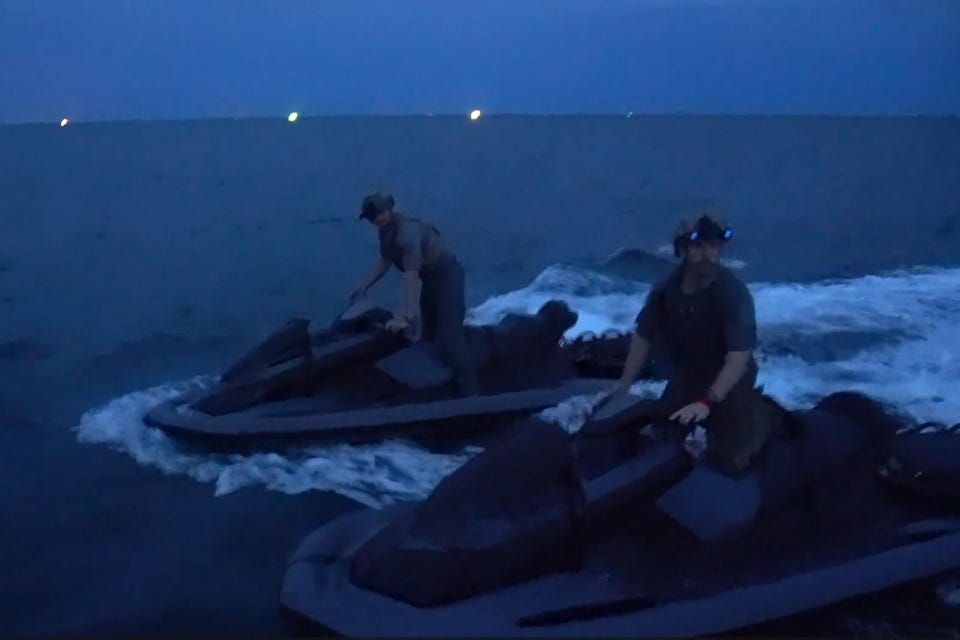
Naval Special Warfare Operating Jet Skis


Ever wondered how the Navy would pluck wounded special forces operators from an enemy beach, fast? Getting off an exposed beach in one piece, under incoming fire, is surely one of the most dangerous operations imaginable. It requires speed and great confidence in the personnel and machines involved. Surprisingly perhaps, commercial off-the-shelf water scooters, similar to the personal watercraft used by water sports enthusiasts the world over, are a popular solution among special forces.

Naval Special Warfare Command’s love of the humble Jet Ski, and they call them that even in official documents, has gone under the radar for many years. But they are now cropping up more and more often in the public domain. The Navy released photos of Jet Skis being used by Special Operations Forces in Greece in 2017, and with Thai forces during Exercise Tempest Wind 2019 in June. Most recently U.S. Special Operations Command issued a request for three Jet Skis to replace ones worn out during training. These will be used by the Naval Special Warfare Basic Training Command in San Diego, California to prepare future Special Warfare Combatant-craft Crewmen (SWCC) who will operate small boats for the US Navy SEALs.

Jet Skis have the advantages of being quick and agile, and can operate in extremely shallow water including through the surf zone to a beach. Their main task is to extract special forces, and they can be used to pick up casualties, downed pilots or prisoners, or be used in counter-terrorism missions. To get where the action is they can be carried by larger boats or, for long range covert missions, in the hangar of the secretive SEAL Insertion, Observation and Neutralization (SEALION). These high speed stealth boats are semi-submersible meaning that they partially sink in order to reduce their radar signatures even further.

The US Navy is not alone in appreciating the merits of water scooters and several NATO special forces units also have them in their inventories. The Navy’s preferred model is the Yamaha FX Cruiser SHO, although other countries use a wide array of competing makes and designs. In Navy service the two or three-seat jet skis are highly modified and fitted with inflatable anti-roll collars and rescue sleds so that equipment or special forces can be towed behind. Naturally the crew can be armed, and machine guns can be fitted to help suppress enemy positions.

In the Persian Gulf the Iranian IRGC (Islamic Revolutionary Guard Corps) use water scooters armed with rocket propelled grenades for reconnaissance and nuisance attacks on commercial shipping.

Special Forces are always experimenting with new ideas and technologies so new adaptions of the Jet Ski have been developed at Sofwerx, a Florida based innovation center which provides rapid prototyping of potential solutions for US Special Operations Command. Earlier this year they tested a submersible personal watercraft which can operate like a regular Jet Ski on the surface, but can also hide beneath the waves. This could allow it to be launched and recovered from a submarine, a capability which currently no Navy has.

Shared from Forbes by H Sutton

Wednesday, October 10, 2018

2019 SEA-DOO SEARCH AND RESCUE (SAR) IS READY TO RESPOND

Sea-Doo went all out with its 2019 Search and Rescue units (SAR). According to Sea-Doo, the SAR watercraft includes the specific features you need in order to respond to life threatening situations. The machines are ideal for rescue situations involving surf, whitewater rafting, floods, or use along rocky coasts. They are equipped with Sea-Doo’s Off-Throttle Assisted Steering to give the operator more maneuverability when laying off the throttle. This helps in aiding people in distress and will also assist in maneuverability in out of tight spaces. It also adds an additional steering effect to the steering mechanism. Read More


Saturday, April 28, 2018

Hawaii Jet Ski Training - 4 POB offshore rough water


K38 and Shawn Alladio-Lead Instructor conducting military training working on our offshore echelon operations with a full load of personnel in rough water.

Thursday, October 19, 2017

Drowning Risks: What You Need to Know and How P2P Rescue Helps

Did you know that drowning is the third leading cause of unintentional deaths with an estimated 360,000 annual drownings worldwide It’s a major public health problem we face, and there are plenty of people, groups, companies and organizations doing helping to prevent drowning, including P2P Rescue! Here’s a few things you should know about drowning risk in our world.

Risk Factors

Age: The three age categories that see the most drownings are 0-5, 20-25, and 60 and older. Drowning is the leading cause of death for toddlers and infants due to the inability to swim, poor adult supervision, and the lack of barriers separating young children from bodies of water. Inadequate supervision is another leading reason why older children are at risk for drowning, as parents sometimes overestimate how well their children obey safety rules when unsupervised. Ages 20-25 see an increase in risk because of participation in water sports and the tendency to be more reckless. For those older than 60, the risk is higher due to difficulty managing themselves in emergency water situations and potential health problems that can lead to heart attacks or low blood pressure while in the water.

Gender: Males are at a higher risk of drowning and are more likely to be hospitalized than females for non-fatal drowning. Studies suggest this is due to an increased exposure to water and generally riskier behavior, including swimming solo and drinking alcohol before swimming or operating a boat alone. Males are also more apt to participate in water sports and live near bodies of water for their careers.

Access to water: There’s always a higher risk when an individual’s occupation is around water, such as working in commercial fishing or using boats. Drowning risk also increases for those who live near open water sources, particularly children in such situations. There’s also a higher risk during warmer months when people travel to bodies of water for vacation and recreation.

Flooding disasters: 75% of drowning deaths occur from natural flooding situations like heavy rain, hurricanes, and tsunamis. This is especially true for people who live in areas that are prone to flooding and have limited options to evacuate.

Drowning Prevention

Although drowning takes a toll around the world, hundreds of thousands of lives are saved every year thanks to trained lifeguards and responders. At P2P Rescue, our goal is to help aid those lifesavers with our unique rescue board designs. From ocean to swift water to flooded conditions, each of our rescue boards are designed to withstand harsh environments and get responders to victims quickly. Take a look at all the boards we offer and see the difference P2P Rescue is making!

Wednesday, October 11, 2017

Wipeout Wearable: Quiksilver’s Inflatable Vest May Save Surfers’ Lives


Surf brand Quiksilver partnered with diving equipment manufacturer Aqua Lung to develop an inflatable flotation device. The Highline Airlift, a CO2-powered inflation vest, aims to lift surfers who fall on big waves. 

Most surfers don’t wear floatation devices, even on sizable waves. Quiksilver wants to change that with the Highline Airlift, an inflatable floatation device small and light enough that it does not encumber athletes riding big waves.

Announced today, Quiksilver claims the Highline Airlift “is the pinnacle of water safety technology.” It uses compressed CO2 to quickly inflate airbags in a manner similar to those used by backcountry skiers caught in avalanches.

It’s worth noting the brand calls out the fact that it is not (legally) considered a PFD in the U.S. or Australia, but is in the European Union. It is “part of a holistic approach to ocean safety.” 

Shared from Gear Junkie


Virginia Beach rescue teams save 3 from rip current near rocks at 1st Street Jetty

VIRGINIA BEACH, Va. WAVY- On Sunday down at the 1st Street Jetty at Rudee Inlet, crews fought back against fierce rip currents and 15-to-20 ...