Saturday, May 1, 2021

National Guard supports joint water rescue exercise


SMYRNA, Tenn. – Members from the Tennessee National Guard, Tennessee Emergency Management Agency, Nashville Fire Department, Rutherford County's StormPoint Emergency Response team and others participated in a joint water rescue exercise April 9.

Tennessee's Helicopter Aquatic Rescue Team, a joint rescue crew with a Tennessee National Guard UH-60L Black Hawk helicopter and aircrew with rescue personnel from the Nashville Fire Department, practiced rescuing drowning victims in Stewarts Creek.

"It's critical that we all train together," said Lt. Col. Jay Jackson, the military liaison for TEMA. "Doing this with people you've never met would be dangerous during a real world emergency, especially in hazardous conditions. That's not when we should be working together for the first time."

During the training event, the Tennessee National Guard helicopter crew lowered a Nashville Fire Department diver into the lake by hoist. The diver swam to the victims, provided aid, and readied them for rescue. Strapping the victims to the rescue strop, diver hooking themselves to the rescue cable and hoisted out of the water into the hovering helicopter. The crew simulated first aid as the survivors were airlifted to the nearest hospital.

"These exercises allow us to streamline the process and strengthen the relationships between the Tennessee National Guard and our state and local partners," said Jackson. "It is all meant to ensure that we are ready to respond to emergencies and protect our fellow citizens. Some of these maneuvers can be dangerous, especially during inclement weather, and we need to be ready."

This year's exercise included an additional element: an unmanned aerial systems team from StormPoint Emergency Response who provided a live feed of the training to the state operations center. Additionally, the team completed a mission delivering life vests to the simulated drowning victims before the HART team's arrival."Our job during this training exercise was to provide situational awareness for the water rescue exercise," said Russell Bradshaw, StormPoint Emergency Response executive director. "We were able to use the drone to locate the victims and provide coordinates and information for the inbound rescue team."

This new capability enhances the Tennessee National Guard's ability, along with local and state partners, to respond to numerous situations, including difficult-to-reach accident sites and major natural disasters, rapidly.

"This new joint capability for Tennessee not only benefits Tennesseans in the event of a disaster but will also be a deployable resource to neighboring states in the event of a disaster out of our area," said Jackson.

The HART team has already completed a successful mission. In October 2020, an injured hiker in North Carolina was successfully hoisted and transported safely to the nearest hospital.

Shared from the US Army

Friday, March 20, 2020

Extractor Pro Model PWC Rescue Sled


Special Aquatic Service (SAS) Water Safety first utilized the Extractor sleds back in 1997 and found them to be invaluable for PWC rescue operations and event support. Today, the Extractor PRO model has been an industry standard for quick rescue pick ups in the surfline, rivers and other near shore situations for the past 20 years. This model, due to its size and weight, is designed for use with PWC’s where a single rescue operator is available to operate the PWC, or may be used in situations where a rescue swimmer is used to assist the victim.

Extractor made the ‘original’ PWC rescue sled in winter of 1991 and patented the water rescue sled back in 1993.  Several revisions have been created over the years to improve durability, performance and adapt the sled to be able to connect with ever-changing hull designs of various personal watercraft.  Current sled designs have features that take into consideration the many different makes and models of personal watercraft.

Not all personal watercraft makes and models are ideal for connecting and using a rescue sled. For the models that do, the optimum connection between personal watercraft and sled differ slightly. Some pwcs already come with hard points ideal for towing, and some pwcs still require installation of hard points onto the rub rails, seat housing, transom or stern in order to provide the most stable and secure connection. 

Taking the time to properly mount your sled is critical: a sled that is too loose or too tight on the transom above the jet, can affect maneuverability and stability. In the worst-case scenario, this could damage your boat, the sled itself, or cause serious injury.

When mounting your sled, you will always want to keep three points for attaching the stern. Some connection systems utilize a solid hitch connection and others use soft rigging, like rope or webbing.  The solid hitch or the middle rope become the main tow point.  Ideally the shorter the connection is between the sled and pwc, the more the board will be stable in the water.

The Extractor Jet Ski Rescue Sled is the result of 30 years of experience, manufacturing several revisions of sleds, using different materials and construction methods along the way. Ultimately, the end users and customers have driven the demand for the current design, using the most durable materials, which can be molded into a hull shape that optimizes functionality for being towed behind a watercraft, which do not delaminate from water pressure working on glued seams, rot from sitting in the salt water or sun, and are recyclable, so they don’t end up polluting the ocean or taking up space in land-fills. The plastic is easily repaired and welded, minimizing time out of commission. 

Check out Extractor Sleds full line of sleds and rescue equipment

Tuesday, February 25, 2020

Rescue Watercraft for the Fire Service


The fire service is the epitome of adapting to the changing environment and the needs of the community. The leadership of the fire service continues to evaluate and meet the needs to our dynamic environments and response districts. The fire service of 2020 is not what the fire service of 2000 was, nor what it was in the ‘90s, ‘80s, or any previous era.

The public’s interest in the fire department goes much deeper than making sure we can handle any fire incident. We are the all-hazards agency that continues to be tasked with greater responsibility for helping those who live in or visit our communities. Many agencies have taken on more increased roles with the same or even less staffing. The term “emergency services” better defines our agencies today as we do much more the fight fires.

An area that has always received our attention is water-related emergencies. Today, we have more options to address emergencies on or in the water. The hazards in water-related rescues are vast and complicated. Swiftwater, ocean, and lake and pond environments have many different features without considering the environmental impacts.

In 2018, the Coast Guard counted 4,145 accidents that involved 633 deaths, 2,511 injuries, and approximately $46 million dollars of damage to property as a result of recreational boating accidents. These accidents contributed to a fatality rate was of 5.3 deaths per 100,000 registered recreational vessels. (1)

Open water is a term that includes natural bodies of water (lakes, rivers, oceans) and man-made bodies of water (canals, reservoirs, and retention ponds). In 2016, open water drownings made up 43 percent of fatal childhood drownings (2).

If your agency has any open water, you must take these statistics seriously, complete a needs assessment, and look for ways to prevent these incidents. Beyond prevention, you must adequately prepare for and respond equipped and trained to rescue those in need.

Read More

Saturday, February 15, 2020

Drifting Towards Catastrophe: What Water Rescue Teams Can Learn from Air Medevac Procedures

RWC Operations Risk Management

By Mike Hudson

On a typical, nondescript summer morning, a fire department water rescue team mulled through their morning preventative maintenance and checklists for its personal watercraft (PWC), which includes confirmation of hull integrity, including the insertion of the bilge’s hull plugs. After the checklist was completed, the rookie on the team was ordered to wash and rinse the inside and outside of the primary PWC, which requires the removal of the bilge plugs. Later that day, the team was dispatched to a water rescue “job” for multiple children caught in a rip current at a neighboring beach. Normally, the unwritten rule is to check the plugs before launching the PWC, but the crew deviated from that step and the craft was hastily launched into the four-foot surf; soon after, the engine compartment flooded, rendering the craft inoperable. Read More

Wednesday, November 27, 2019

Jet ski driver completes incredible rescue of big wave surfer at Nazaré


This is the dramatic moment a jet ski driver pulled off an incredible rescue of a big wave surfer at Nazaré in Portugal. The drone footage shows professional surfer Lucas Chumbo being towed into a monster wave on November 20th. 

After an impressive ride, the Brazilian exits the wave successfully and waits for his teammate Ian Cosenza to pick him up on the jet ski. However, as Cosenza approaches Chumbo, another huge wave rolls towards them threatening to flatten them both in the impact zone. Chumbo manages to grab onto the sled on the back of the jet ski and 

Cosenza accelerates as fast as he can towards the shore. But the drama doesn't end there: the two are now pursued by a mass of white water travelling at 60 miles per hour which quickly catches the pair and swallows them up. When something like this happens it generally doesn’t end well but against all odds, Cosenza manages to ride the jet ski out of the mountain of churning foam and get them both to safety. 

The WSL (World Surf League) described this as “one of the craziest rescues ever seen.” Chumbo is currently one of the best big wave surfers in the world.


Thursday, September 19, 2019

Secret Service Wants Jet Skis to Protect Trumps: 'The First Family is Very Active in Water Sports'


The United States Secret Service wants to purchase two jet skis that would be used to train agents and help protect President Donald Trump—along with his family and friends—while at vacation properties located near the water, such as his exclusive south Florida Mar-a-Lago resort, according to an order request posted Monday.

The federal agency requested two Kawaski jet skis, watercrafts that each retail from $9,999 to $15,299. The request noted security challenges that special agents face when traveling with Trump to places such as Mar-a-Lago and the Hamptons.

"President Trump and his family spend several weeks throughout the year in Mara Largo FL and Hamptons NY. The First Family is very active in water sports," the request reads, which was first highlighted by Washington-based WRC-TV reporter Scott McFarlane.

"Several family members along with their guest participate in open water activities for which USSS Special Agent Rescue Swimmers are responsible," the request continues. "SA's have rented watercraft with their own personal funds to allow them to be near our protectees in various water environments to fulfill the USSS Rescue Swimmer mission."

The Secret Service said the jet skis would primarily be used for training exercises and would be stored at a training facility in Beltsville, Maryland. They would be transported via a dual trailer, which the agency also wishes to purchase.

's unclear as to when the jet ski quotes are due, considering the posting lists Tuesday but also says September 18 as the deadline, which would be Wednesday.

Currently, the Secret Service provides rescue watercraft training in North Carolina during a one-day course. However, the agency explained in its request, a three- or four-day training course provided by agents who are rescue swimmer instructors would be "more appropriate to become a proficient operator/rescuer on a" rescue watercraft.

The jet skis will "be outfitted with rescue sleds (in a separate purchase) that will be used by USSS Rescue Swimmers as training tools, as well as assets that can be used on a variety of protective missions, as needed," the request added.

The Secret Service also noted the agency's former partnership with local officials in Hawaii for when former President Barack Obama and his family vacationed there, stating that rescue swimmers used and trained with jet skis for the same reasons.

Sunday, August 25, 2019

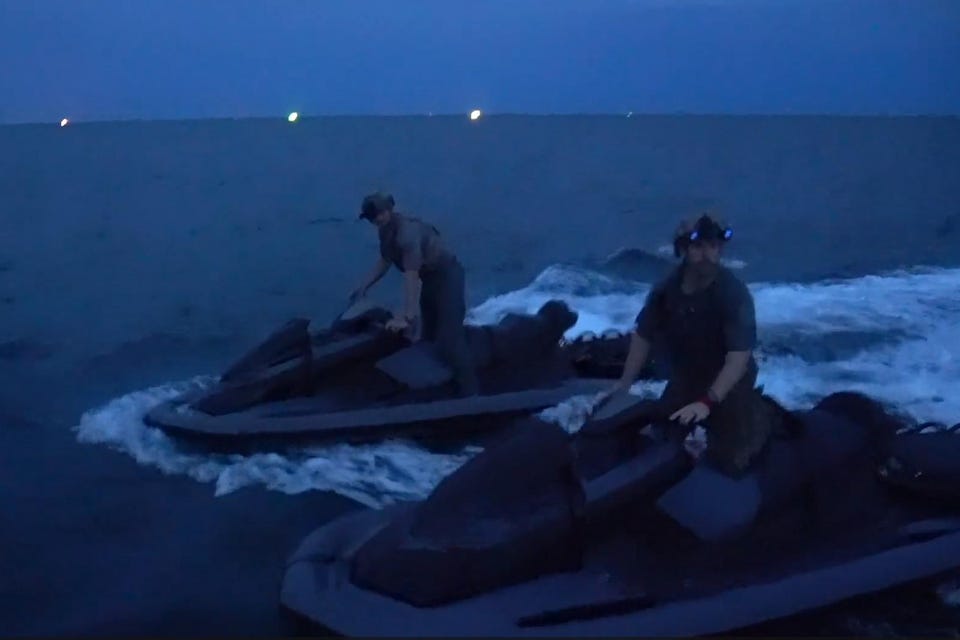
Naval Special Warfare Operating Jet Skis


Ever wondered how the Navy would pluck wounded special forces operators from an enemy beach, fast? Getting off an exposed beach in one piece, under incoming fire, is surely one of the most dangerous operations imaginable. It requires speed and great confidence in the personnel and machines involved. Surprisingly perhaps, commercial off-the-shelf water scooters, similar to the personal watercraft used by water sports enthusiasts the world over, are a popular solution among special forces.

Naval Special Warfare Command’s love of the humble Jet Ski, and they call them that even in official documents, has gone under the radar for many years. But they are now cropping up more and more often in the public domain. The Navy released photos of Jet Skis being used by Special Operations Forces in Greece in 2017, and with Thai forces during Exercise Tempest Wind 2019 in June. Most recently U.S. Special Operations Command issued a request for three Jet Skis to replace ones worn out during training. These will be used by the Naval Special Warfare Basic Training Command in San Diego, California to prepare future Special Warfare Combatant-craft Crewmen (SWCC) who will operate small boats for the US Navy SEALs.

Jet Skis have the advantages of being quick and agile, and can operate in extremely shallow water including through the surf zone to a beach. Their main task is to extract special forces, and they can be used to pick up casualties, downed pilots or prisoners, or be used in counter-terrorism missions. To get where the action is they can be carried by larger boats or, for long range covert missions, in the hangar of the secretive SEAL Insertion, Observation and Neutralization (SEALION). These high speed stealth boats are semi-submersible meaning that they partially sink in order to reduce their radar signatures even further.

The US Navy is not alone in appreciating the merits of water scooters and several NATO special forces units also have them in their inventories. The Navy’s preferred model is the Yamaha FX Cruiser SHO, although other countries use a wide array of competing makes and designs. In Navy service the two or three-seat jet skis are highly modified and fitted with inflatable anti-roll collars and rescue sleds so that equipment or special forces can be towed behind. Naturally the crew can be armed, and machine guns can be fitted to help suppress enemy positions.

In the Persian Gulf the Iranian IRGC (Islamic Revolutionary Guard Corps) use water scooters armed with rocket propelled grenades for reconnaissance and nuisance attacks on commercial shipping.

Special Forces are always experimenting with new ideas and technologies so new adaptions of the Jet Ski have been developed at Sofwerx, a Florida based innovation center which provides rapid prototyping of potential solutions for US Special Operations Command. Earlier this year they tested a submersible personal watercraft which can operate like a regular Jet Ski on the surface, but can also hide beneath the waves. This could allow it to be launched and recovered from a submarine, a capability which currently no Navy has.

Shared from Forbes by H Sutton

Virginia Beach rescue teams save 3 from rip current near rocks at 1st Street Jetty

VIRGINIA BEACH, Va. WAVY- On Sunday down at the 1st Street Jetty at Rudee Inlet, crews fought back against fierce rip currents and 15-to-20 ...